
Why Limescale Forms and Why Some Cleaning Methods Fail

By Alex , Founder of Cleaning24NL
Engineer with a background in Natural Gas & Petroleum Engineering and 10+ years of professional cleaning experience.
Limescale looks simple: a pale, crusty ring in a kettle, a cloudy film on a shower screen, a rough collar around a tap. Chemically, it is anything but random. It forms because water, minerals, heat, air and surfaces keep pushing a reversible reaction in one direction.
That is also why some cleaning methods disappoint. A cleaner can smell strong and still do little. A surface can fizz for seconds and remain crusty. A kettle can look clean after descaling, then grow a new white layer within days.
The key is chemistry. Once the chemistry makes sense, limescale stops being a mystery stain and starts behaving like a predictable mineral deposit.

Limescale begins when water carries dissolved rock
Most limescale starts long before water reaches a kettle, tap or shower head. Rainwater falls through the air and absorbs a little carbon dioxide. That creates weak carbonic acid.
Carbonic acid is mild, but over time it can dissolve minerals from rock and soil. In areas with limestone or chalk, the water picks up calcium and magnesium compounds. This is what people mean by hard water.
The main mineral behind limescale is calcium carbonate, written as `CaCO3`. In solid form, calcium carbonate does not dissolve very well in pure water. Add dissolved carbon dioxide, though, and the chemistry changes.
A simplified version looks like this:
`CaCO3 + CO2 + H2O → Ca(HCO3)2`
Calcium carbonate reacts with carbon dioxide and water to form calcium bicarbonate. Calcium bicarbonate is much more soluble, so it can travel invisibly in water. The water looks clear, but it is carrying mineral material in dissolved form.
This is why hard water does not usually arrive with visible grit floating in it. The minerals are present as ions, mainly calcium ions, magnesium ions and bicarbonate ions. They only become obvious when conditions change.
Hardness usually comes in two broad forms.
Type of hardness | Main cause | What happens during heating |
Temporary hardness | Calcium and magnesium bicarbonates | Often forms limescale when heated |
Permanent hardness | Sulphates, chlorides and other salts | Less affected by boiling |
The word “temporary” can be misleading. It does not mean the problem is minor. It means the hardness can be reduced by boiling because bicarbonate compounds break down when heated.
That breakdown is the start of many familiar limescale problems.
Hard water varies across the UK. Chalk and limestone areas tend to have harder water, while areas supplied by upland reservoirs and granite regions often have softer water. The exact mix depends on the water source, treatment process and local geology.
The most useful point is simple: if water has carried dissolved calcium and bicarbonate into the home, limescale can form whenever that chemical balance changes.
Heat, air and evaporation push minerals out of solution
Limescale forms when dissolved minerals leave the water and become solid again. Heat is one of the most common triggers.
Inside a kettle, hot water loses dissolved carbon dioxide more easily. As carbon dioxide escapes into the air, the earlier reaction starts to reverse:
`Ca(HCO3)2 → CaCO3 + CO2 + H2O`
That solid `CaCO3` is limescale.
This is why kettles, boilers, coffee machines and hot taps often suffer more than cold-water plumbing. They create exactly the conditions that help dissolved calcium turn back into solid calcium carbonate.
Heat is not the only factor. Limescale also forms faster when water evaporates. If a droplet dries on a shower screen or tap, the water leaves but the minerals remain. Each dried droplet can add a tiny amount of mineral residue. Over time, the surface turns cloudy, then rough, then visibly crusted.
This is why shower glass can become marked even when it is not heated to kettle temperatures. Warm spray, repeated evaporation and hard water are enough.
Surfaces matter too. Smooth surfaces resist deposits better than scratched or rough ones. A tiny scratch, pit or patch of old scale gives new crystals somewhere to start growing. Chemists call these starting points nucleation sites. In daily life, they are the reason limescale often returns first to the same places:
The seam around a tap base
The spout of a kettle
Shower head nozzles
Rubber seals and textured plastic
Scratched enamel or old ceramic
Once the first layer forms, it can make the next layer easier to build. The crust creates more surface area and traps droplets. That is why neglected limescale often seems to speed up.
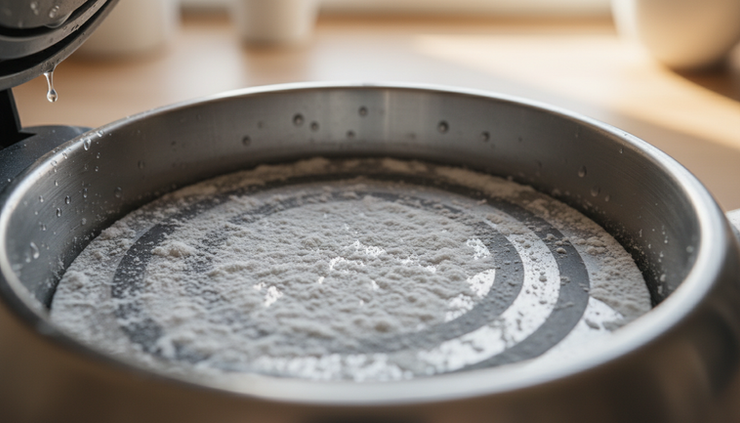
Limescale is not always pure calcium carbonate. It can contain magnesium compounds, traces of iron, silica, soap residues and other minerals. Magnesium bicarbonate can also break down during heating, and under some conditions magnesium hydroxide can appear in deposits.
This mixed chemistry explains why one patch of scale may dissolve quickly while another patch resists the same cleaner. The visible crust may be a layered deposit, not a single substance.
The form of calcium carbonate can vary too. Calcite and aragonite are both crystal forms of calcium carbonate. They share the same chemical formula, but their crystal structures differ. In practical cleaning terms, dense, older deposits often take longer to dissolve because acid has to work from the outside in.
A thin film on glass is mostly a surface problem. A thick crust in a kettle is a mineral mass. They need similar chemistry, but not always the same method.
Acids remove limescale by turning carbonate into soluble salts
Limescale cleaners work best when they attack carbonate chemistry directly. That usually means using an acid.
Calcium carbonate reacts with acids to form a soluble calcium salt, water and carbon dioxide gas. The gas is the fizz people often notice.
A simple version using hydrochloric acid looks like this:
`CaCO3 + 2HCl → CaCl2 + CO2 + H2O`
Household cleaners do not need to use hydrochloric acid to work. Vinegar, citric acid and lactic acid can all dissolve calcium carbonate because they supply hydrogen ions that react with carbonate.
The fizz is not the cleaning power itself. It is a sign that acid is reacting with carbonate. When fizzing slows or stops, several things may have happened:
The acid has been used up
The outer carbonate layer has dissolved
The remaining deposit contains less carbonate
The cleaner is no longer reaching the scale
The solution has become diluted with water
This matters because people often mistake fizz for completion. A cleaner can fizz dramatically at first, then leave behind plenty of scale. The reaction may have stopped because the available acid ran out, not because the job finished.
Different acids behave differently.
Acid or cleaner type | Common use | Strengths | Limits |
White vinegar | Kettles, taps, light scale | Cheap and widely available | Smell, slower on thick deposits |
Citric acid | Kettles, coffee machines, shower heads | Good at binding calcium, less vinegar smell | Needs enough contact time |
Lactic acid | Bathroom descalers | Often suitable for routine bathroom scale | May struggle with heavy crusts |
Sulphamic acid | Stronger descaling products | Effective on tougher deposits | Needs careful use as directed |
Hydrochloric acid | Some heavy-duty toilet cleaners | Fast on carbonate deposits | Can damage metals and surfaces, gives off harsh fumes |
Citric acid has a useful extra trick. It does not only provide acidity. It can also bind calcium ions in solution, a process called chelation. By holding calcium in dissolved form, it helps stop the dissolved minerals from immediately settling back out.
That said, no acid is magic. Acid needs contact with the mineral. If the cleaner runs straight off a vertical surface, it may barely react. If the limescale is hidden inside a shower head nozzle, the acid may not reach the blockage unless the part is soaked. If a deposit includes grease or soap scum, acid may reach the carbonate unevenly.
This is where cleaning becomes both chemistry and method. The right chemical still needs enough time, concentration and contact.
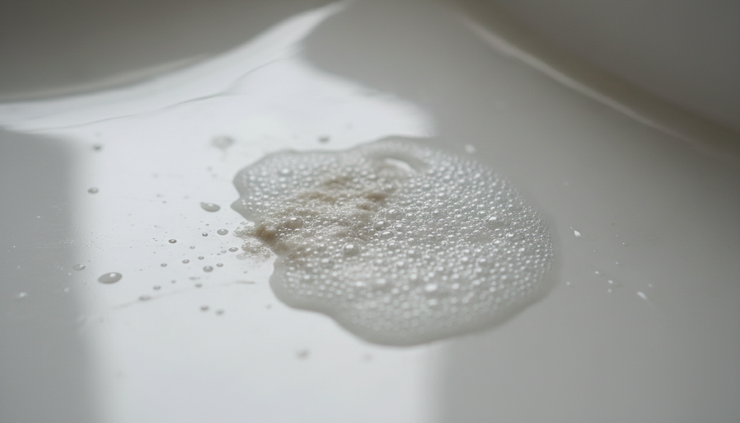
One common mistake is using alkaline cleaners on limescale. Bleach, washing soda and many soap-based cleaners are alkaline. They can be good for other jobs, but they do not dissolve calcium carbonate in the same way acids do.
Bleach may whiten a stained area and kill mould nearby, but it does not remove mineral scale effectively. After bleaching, the deposit can look cleaner while still feeling rough. The mineral is still there.
Baking soda has a similar limitation. It is mildly alkaline and mildly abrasive. It can help scrub a surface film, but it does not chemically dissolve limescale well. Mixing baking soda with vinegar creates fizz, but much of that fizz comes from the acid reacting with the bicarbonate in the baking soda instead of the carbonate in the limescale. The mixture can neutralise itself before it has done much useful descaling.
That does not mean abrasives have no place. Gentle mechanical action can help remove loosened deposits. But relying on scrubbing alone often scratches surfaces and creates more places for new scale to grip.
Cleaning fails when the chemistry or the conditions are wrong
When limescale survives cleaning, it is usually for a clear reason. The cleaner may be wrong for the deposit, or the method may stop the chemistry from working.
The cleaner is not acidic enough
Light vinegar can remove light scale. Thick kettle crusts or old deposits around taps may need a stronger acid, repeated treatment or longer soaking.
An acid becomes weaker as it reacts. Every bit of calcium carbonate consumes some of the acid. If the amount of scale is large and the amount of acid is small, the cleaner can be spent before the deposit has dissolved.
This is why topping a scaled kettle with a small splash of vinegar may only clean a ring at the waterline. The acid has not reached enough of the deposit, and there may not be enough acid present.
The acid cannot stay on the surface
Limescale on vertical surfaces is harder to treat because liquid runs down. A descaler that works well inside a kettle may fail on shower glass simply because it does not stay in place.
Gel products, soaked cloths and removable soaking bags work because they improve contact time. They keep acid touching the mineral long enough for the reaction to continue.
For taps, wrapping the scaled area in a cloth soaked with citric acid solution or vinegar can work better than repeated spraying. The chemistry is the same, but the contact is better.
The deposit is mixed with soap scum or grime
Bathroom scale often contains more than mineral. Soap scum forms when fatty soap molecules react with calcium and magnesium ions. This creates sticky, insoluble residues that cling to tiles, glass and baths.
Soap scum and limescale can layer together. Acid attacks the carbonate, but it may not cut through oily residue well. A detergent cleaner may remove grease and soap film, but it may not dissolve mineral.
That is why a two-step method often works better on shower areas:
Clean body oils and soap film with a suitable bathroom detergent.
Rinse, then treat the mineral scale with an acid descaler.
Doing both at once can work for light deposits, but heavy mixed residue often needs separate steps.
The water keeps re-depositing minerals
Rinsing with hard water removes cleaner, but it can also leave fresh minerals behind as it dries. This is why a shower screen may look clear when wet and cloudy again once dry.
For glass and chrome, drying the surface after rinsing makes a real difference. It removes the water before evaporation can leave minerals behind.
A squeegee in the shower is not exciting chemistry, but it works because it interrupts the deposition process.
The surface reacts badly with the cleaner
Acid dissolves limescale, but it can also damage some materials. Natural stone such as marble and limestone contains calcium carbonate. That means acid can attack the surface itself. A vinegar splash on marble can leave a dull etched mark because it dissolves the stone, not just the scale.
Acid can also harm some metals, finishes and grouts if used too strongly or left too long. Chrome taps often tolerate mild descaling when done carefully, but damaged plating or exposed metal can react poorly. Aluminium can be particularly sensitive to some descalers.
The rule is simple: match the cleaner to both the deposit and the material underneath.
Always follow the product label, test discreetly if unsure, and avoid leaving acid on surfaces longer than recommended.
Bleach and acid are a dangerous mix
Some cleaning failures are more than annoying. They can be unsafe.
Never mix bleach with acidic descalers, vinegar, citric acid or toilet cleaners. Acid can react with bleach to release chlorine gas. Do not layer cleaners in a toilet bowl, shower tray or sink without rinsing thoroughly between products.
Also avoid mixing different descaling products together. Stronger is not always better. Mixed chemicals can produce fumes, heat or unwanted reactions.
The best descaling method follows the deposit
A good limescale cleaning plan starts with three questions.
What is the surface made from?
How thick is the deposit?
Can the cleaner stay in contact long enough?
The answers decide the method.
For a kettle, citric acid is often a clean, low-odour choice. Dissolve it in water, heat according to the product instructions or common appliance guidance, let it sit, then rinse very thoroughly. If any flakes remain, wipe gently rather than scraping hard at the heating plate.
For a shower head, soaking works better than spraying. If the head can be removed, soak it in a suitable descaling solution. If not, a bag or container held around the head can keep the acid in contact with the nozzles. Rinse well afterwards and run water through the head to clear loosened particles.
For taps, use a soaked cloth rather than pouring cleaner over the fitting. Keep the solution on the scale, not all over surrounding stone, grout or sensitive finishes. Check it regularly. Once the scale softens, wipe rather than gouge.
For glass, remove soap film first if the surface feels greasy or smeary. Then use an acid-based cleaner suited to bathroom glass. Rinse and dry. If the scale has etched the glass over time, cleaning may remove the mineral but not fully restore the surface. Etching is actual surface damage, not dirt.
For toilets, limescale often sits below the waterline. A descaler needs to reach the deposit without being too diluted. Some toilet cleaners are acidic for this reason. Never combine them with bleach products, and follow the label closely.

Prevention uses the same chemistry in reverse. The aim is to reduce mineral concentration, reduce evaporation marks or stop crystals from gripping.
Good prevention habits include:
Wiping taps and shower glass dry after use
Descaling kettles before a thick crust builds
Cleaning shower heads before nozzles clog
Using appliance descalers according to the manufacturer’s instructions
Considering water softening where hard water causes repeated appliance problems
Water softeners work because they change the minerals in the water before those minerals can form hard carbonate scale. Ion-exchange softeners typically swap calcium and magnesium ions for sodium or potassium ions. The result is water that is less likely to form hard limescale.
Scale inhibitors and magnetic or electronic devices are more debated. Some may change how minerals crystallise under certain conditions, but results can vary. They should not be treated as a guaranteed substitute for softening where scale is severe.
The simplest prevention still matters most: do not let hard water dry repeatedly on the same surface.
Limescale is persistent because it is not just dirt sitting on top of a surface. It is a mineral deposit created by shifts in water chemistry. Heat removes carbon dioxide. Evaporation concentrates dissolved minerals. Rough surfaces give crystals a place to grow. Acid reverses the build-up by reacting with carbonate and keeping calcium in solution.
When cleaning fails, the failure usually has a reason. The product may be alkaline. The acid may be too weak or spent. The deposit may be mixed with soap scum. The cleaner may not have enough contact time. The surface may not tolerate the acid needed to remove the scale.
Once those limits are clear, limescale becomes easier to manage. Use acid where carbonate is the problem, use detergent where grease and soap film are in the way, give the reaction time, rinse safely, and dry surfaces before minerals can settle again.


Comments